- Java 7 is available only for Mac OS 10.7 and higher. Use Apple's Software Update to upgrade to Java 6 update 45. Apple has not released security fixes for Java 6 update 45 and known security issues exist.
- Java 1.7.021 download. Java Plug-in technology, included as part of the Java 2 Runtime Environment, Standard Edition (JRE), establishes a connection between popular browsers and the Java platform. Java allows applications to be downloaded over a network and run within a guarded sandbox.


Last updated on SEPTEMBER 29, 2020
Run the downloaded installer, which installs both the JDK (Java Development Kit) and JRE (Java Runtime). By default, the JDK and JRE will be installed into directories 'C: Program Files java jdk1.7.0' and 'C: Program Files java jre7', respectively.
Applies to:
Oracle iLearning - Version 6.0 and laterInformation in this document applies to any platform.
Goal
Java Plug-in version 1.7.0_21 introduces the following security requirements for applets:
1. All applets must be signed
2. Permissions attributes must be specified in the .jar file manifest Since 1.7.0_51, live connect (applet communication with javascript) must use version u51.
Java does not support live connect in versions before u51.
Solution
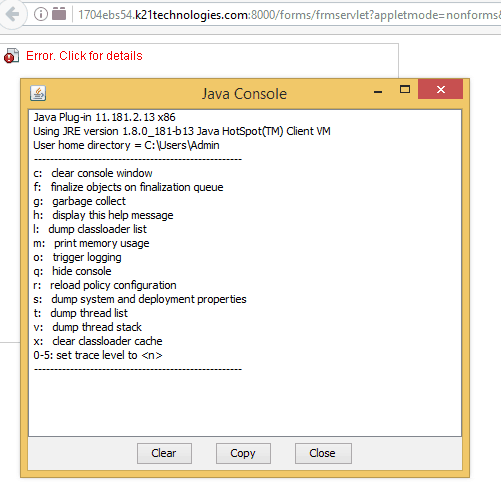
To view full details, sign in with your My Oracle Support account. |
Don't have a My Oracle Support account? Click to get started! |
| Goal |
Install Java 1.7 0_21 Tutorial
| Solution |
| References |
Java is a computer programming language that is concurrent, class-based and object-oriented. It was originally developed by James Gosling at Sun Microsystems. Java applications are compiled to bytecode (class file) that can run on any Java virtual machine (JVM) regardless of computer architecture.
Java is currently owned by the Oracle Corporation which acquired Sun Microsystems in 2010. Following tutorial will show you how to setup and configure Java 1.7 on Windows so you can develop and run Java code.
Check following posts if you are looking to download and install JDK 1.5, JDK 1.6, JDK 1.8, JDK 1.9 or JDK 1.10.
Java Plugin 1 7 0.21
Java can be obtained from the Oracle Java download page. There are a number of different Java packages available, for this tutorial we will be installing Java Standard Edition (SE) on Windows.
In order to be able to compile Java code, we need the Java Development Kit (JDK) package that comes with a Java compiler. The JDK package also comes with a Java runtime environment (JRE) that is needed to run compiled Java code.
As we are installing an older Java version, you need to scroll all the way down to the bottom of the Oracle Java download page and click on the Download button in the Java Archive section. Then look for the Java SE 7 link and after clicking on it, select the correct operating system under Java SE Development Kit 7u80.
Here is the direct link to download the jdk 1.7.0_80 installer for Windows 32 or 64 bit.
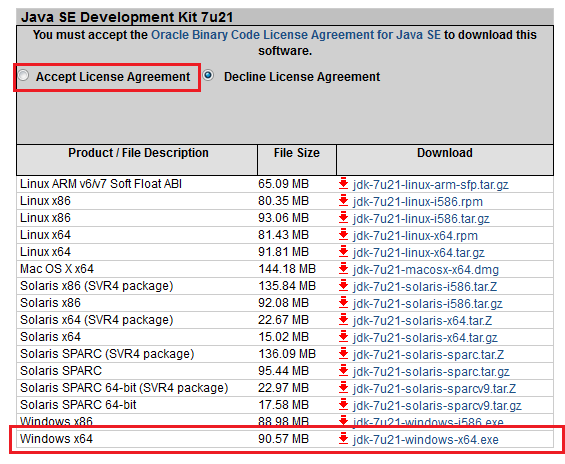
Accept the License Agreement and pick the correct download for your operating system. In this example, we will use the Windows 64 bit version.
Sign in using your Oracle account (or create a new one) and the download should start. Once the download is complete, locate the jdk-7u80-windows-x64.exe file and double-click to run the installer.
Click Next and on the following screen optionally change the installation location by clicking on the Change... button. In this example the install location was changed to 'C:Javajdk1.7.0_80'. From now on we will refer to this directory as: [java_install_dir].
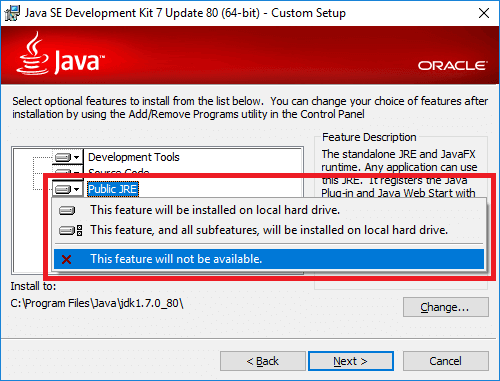
Next, the installer will present the installation location of the public JRE. We will skip this part of the installer as the JDK installed in the previous step comes with a private JRE that can run developed code. Just press Cancel and confirm by clicking Yes in the popup window.
Click Next and then Close to finish installing Java.
In order for Java applications to be able to run we need to setup a 'JAVA_HOME' environment variable that will point to the Java installation directory. In addition, if we want to run Java commands from a command prompt we need to setup the 'PATH' environment variable to contain the Java bin directory.
When using Windows the above parameters can be configured on the Environment Variables panel. Click on the Windows Start button and enter “env” without quotes as shown below.
Environment variables can be set at account level or at system level. For this example click on Edit environment variables for your account and following panel should appear.
Click on the New button and enter “JAVA_HOME” as variable name and the [java_install_dir] as variable value. In this tutorial the installation directory is 'C:Javajdk1.7.0_80'. Click OK to to save.
Java 8 Update 121 Download
Click on the New button and enter “PATH” as variable name and “%JAVA_HOME%bin” as variable value. Click OK to save.
Note that in case a 'PATH' variable is already present you can add “;%JAVA_HOME%bin” at the end of the variable value.
The result should be as shown below. Click OK to close the environment variables panel.
In order to test the above configuration, open a command prompt by clicking on the Windows Start button and typing “cmd” followed by pressing ENTER. A new command prompt should open in which the following command can be entered to verify the installed Java version:
The result should be as shown below.
This concludes the setting up and configuring JDK 1.7 on Windows.
If you found this post helpful or have any questions or remarks, please leave a comment.